
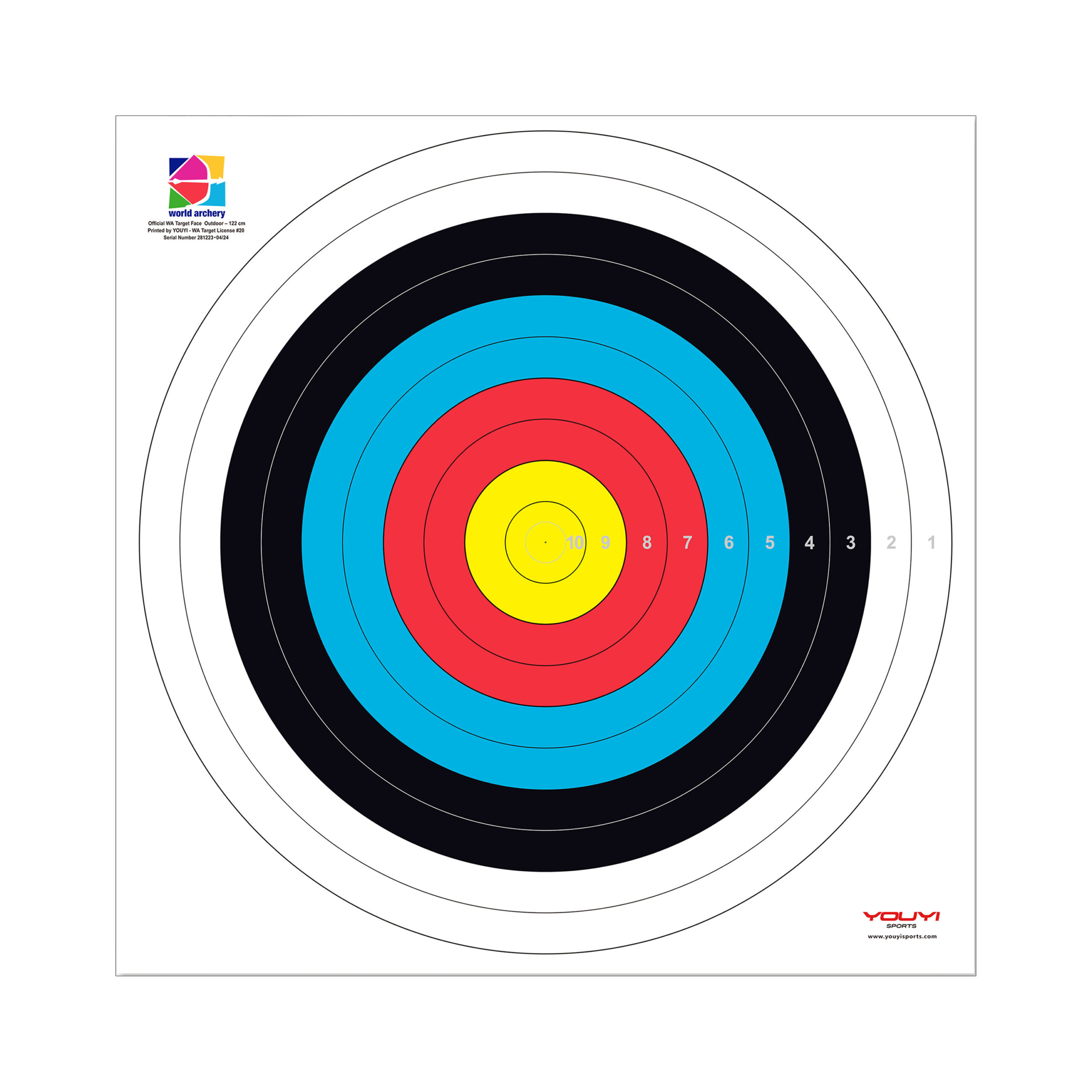
In standard target archery, a hit scores according to the highest-value scoring zone touched by the arrow shaft: the centre is worth 10 points and values decrease to 1 at the outer scoring ring. A miss scores zero. Competition formats can add details, so follow the round’s rules.
Key Takeaways
Most standard target faces divide the scoring area into ten rings worth 1 through 10, with gold at the centre and white at the outside. An arrow touching a boundary line receives the higher value. Event rules define target size, number of arrows, and any inner-10 or tie-break procedure.
- The centre gold rings score 10 and 9; the outer white rings score 2 and 1.
- A line cutter touching a higher scoring zone normally takes that higher value under the applicable rules.
- Check the event format for target face, distance, arrows per end, and tie-break rules.
How does archery target scoring work?
Archers shoot a set number of arrows at a target face and add the point value for each arrow. On a common ten-zone face, the innermost ring scores 10, the next ring 9, and values continue outward to 1. An arrow outside the scoring area or a complete miss scores zero.
An end is one group of arrows shot before scoring and retrieval. For example, arrows scoring 10, 9, and 7 make an end total of 26. The number of arrows per end and total ends depend on the round; a practice session may use a different format from a sanctioned competition.
What are the archery target ring colours and values?
On the standard five-colour target face, each colour contains two scoring zones. Gold is 10 and 9, red is 8 and 7, blue is 6 and 5, black is 4 and 3, and white is 2 and 1. The miss area outside the scoring rings is zero.
| Target colour | Scoring rings | Points |
|---|---|---|
| Gold / yellow | Inner and outer gold | 10 and 9 |
| Red | Inner and outer red | 8 and 7 |
| Blue | Inner and outer blue | 6 and 5 |
| Black | Inner and outer black | 4 and 3 |
| White | Inner and outer white | 2 and 1 |
| Outside scoring area | No scoring ring touched | 0 |
Target faces can be printed with fewer visible rings or a different layout for a particular round. The scoring values depend on the rules being used, not just the face’s colours. For practice, a correctly sized target face on an arrow-stopping buttress gives you a clear place to record groups safely.
How is a line cutter scored?
If the arrow shaft touches a boundary line between two scoring zones, it is normally awarded the higher score of the two zones. Archers should agree on close calls before removing arrows; in a formal competition, the judge applies the rules and any approved gauge.
Look at the shaft where it crosses the line, not the hole left in a worn target face. Do not move or pull the arrow before the value is agreed. If your group cannot decide during practice, mark the score as unresolved and ask a coach or event judge rather than turning or pressing the shaft.
Why can target scoring differ between events?
The 1-to-10 ring values explain the common target face, but an event can specify a division, target size, distance, arrow count, inner-ring procedure, or tie-break method. Check the published rules for your round rather than assuming every club session uses the same target or scoring details.
| Scoring detail | What is usually consistent | What to confirm for the round |
|---|---|---|
| Ring values | Standard ten-zone face counts from 10 at centre down to 1 outside | Whether that round uses a full face, reduced face, or another scoring format |
| Arrow values | Each arrow receives the value of its scoring zone | How line cutters, misses, equipment failures, and judge calls are handled |
| Total score | Arrow values are added across ends | Arrows per end, number of ends, inner-10 use, and tie-break rules |
World Archery’s target archery overview describes the standard ring system; sanctioned events follow their current rulebook. For home practice, Suhag Archery has 80 cm 10-ring target faces and 122 cm target faces. Choose a face and buttress suitable for your bow and session, and follow your range’s safety rules.
If you are new to the sport, the beginner’s guide to archery covers basic range routines. For equipment context, see compound versus recurve bows.
How does target scoring apply to traditional and Indian archery?
The 1-to-10 explanation applies when a traditional or Indian archery event uses that target face and rule set. Other events may use different target shapes, distances, arrow counts, or scoring systems. Check the specific federation, club, or competition rules before comparing scores across formats.
For club practice, agree on the target face and scoring method before shooting. Do not treat a score from one traditional event format as directly comparable with a World Archery target round unless both use the same rules.
Frequently Asked Questions
These answers cover common scoring questions for a standard ten-zone target. Always use the current rules for your competition if they differ from this general explanation.
How many points is the gold ring in archery?
On a standard ten-zone target, the two gold rings are worth 10 and 9 points.
What does an arrow touching a line score?
Under standard target rules, an arrow touching the line between zones receives the higher score, subject to the event’s judging rules.
How many points is a miss in archery?
A miss outside the scoring area scores zero on a standard target round.
Is the centre X worth more than 10 points?
Not in every event. An X or inner 10 may be used for tie-breaking or recorded separately, so check the round’s rules.
References: World Archery target archery overview and the 2026 World Archery rulebook, Book 2.