
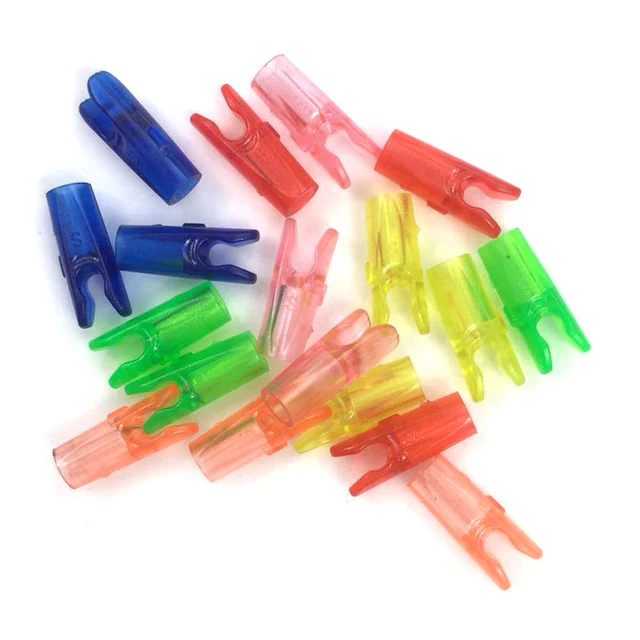
Arrow nock fit is the match between an arrow’s nock groove and the bowstring’s center serving. A correct fit holds the arrow’s weight when it hangs from the string, yet releases with a light tap. Exact nock and serving combinations depend on the arrow and its maker’s instructions.
Key Takeaways
- The nock should hold the arrow’s weight but release with the maker’s tap check.
- Nock groove size and center-serving diameter work together to determine fit.
- Never bend, force or shoot-test a nock to make it fit.
What is arrow nock fit?
Arrow nock fit describes how firmly the groove catches the string’s center serving. The nock should stay attached while the arrow hangs under its own weight and separate under the maker’s recommended tap check. The fit depends on nock groove size and serving diameter, not just arrow length or color.
The nock is the grooved part at the back of the arrow. The center serving is the protective wrapping around the middle of the bowstring where the arrow clips on. A fit problem can come from a mismatched groove, serving or nocking-point setup.
How tight should an arrow nock fit the bowstring?
For many target setups, a correctly fitted nock supports the arrow when it hangs from the string, then separates with a light or sharp tap on the serving near the nock. The exact test varies; use the arrow maker’s direction rather than applying the same force to every nock.
Easton describes a gravity-and-tap check for its nocks: the arrow should remain attached under its own weight and come free when the serving is tapped near the nock. World Archery’s coaching material describes checking nock fit while building center serving. These are useful examples, but follow the instructions for your exact equipment: Easton’s nock-fit guidance and World Archery’s equipment manual.
How can you check arrow nock fit safely?
Check fit at rest: keep the strung bow in a safe area, hold it horizontally so the arrow points down, and attach the nock normally. Tap the serving at the maker’s specified spot and check whether the nock releases. Never draw or shoot the arrow as a fit test.
- Make sure the bow is safely strung and that nobody is in front of or below the arrow.
- Clip the arrow onto the serving at its normal position, clear of any nocking-point indicators.
- Hold the bow horizontally so the arrow hangs down. Use the maker’s specified tap on the serving near the nock; the arrow should release as directed.
- If the arrow falls without a tap or stays attached after the check, stop and ask a coach or bow technician to check the nock and serving.
Easton’s setup guide gives one example using a tap about 1–2 inches (2.5–5 cm) from the nock. That distance is the maker’s guidance for its equipment, not a universal measurement. Read Easton’s full setup instructions before applying that particular check.
What do loose, correct and tight nock fits look like?
A loose nock can fall from the string without a tap; a tight nock may remain attached after the maker’s check. Correct fit is secure under the arrow’s weight and releases as instructed. Stop and correct any fit that feels forced, pinched or inconsistent.
| Fit | What you may observe | What to check |
|---|---|---|
| Correct | The arrow stays attached under its own weight and releases during the maker’s tap check. | Confirm the nock and serving are undamaged and the nock is not pinched by indicators. |
| Too loose | The arrow drops off without a tap or will not stay clipped during normal handling. | Check that the groove size and serving diameter match the arrow and bowstring. |
| Too tight | The arrow stays attached after the maker’s tap check or requires force to clip on or remove. | Ask a coach or bow technician to check compatibility and serving size; do not bend the nock. |
A loose fit can let an arrow come off the string when the bow is moved or drawn, so do not shoot until the cause is corrected. A tight fit should also be checked rather than forced; manufacturers recommend matching the nock groove and center serving instead of reshaping the nock.
Can nocking points make an arrow nock too tight?
Nocking-point indicators set the arrow’s height on the string; they are separate from how the groove grips the serving. Leave enough room that indicators do not pinch the nock. Easton notes that a pinched nock can be pushed off at full draw, so have a coach verify the setup.
Easton describes approximately 1–2 mm between the nock and lower indicator as typical in its setup guidance, while the right clearance can depend on the bow and nock. Do not copy a measurement blindly: ask a coach to check the bow at brace height and through the draw.
How do you choose a replacement arrow nock?
Choose a nock that matches the arrow’s pin or shaft, then confirm its groove size suits the bowstring serving. A product label alone is not enough: manufacturers use different designs and size systems. Check the shaft or nock maker’s compatibility guidance before installing a replacement.
For example, Beiter’s manufacturer information identifies its asymmetric pin nocks in #1 (small-groove) and #2 (large-groove) sizes. Suhag Archery lists Beiter Asymmetric Pin Nocks and a nock category. These are pin nocks, so first confirm that your arrow uses a compatible pin and select a groove that fits your serving.
If you are replacing a nock after an impact, inspect the shaft and nearby fletching too. Our guides to checking carbon arrows for damage, arrow spine, arrow length and arrow fletching cover related parts of safe arrow selection and care.
Does arrow nock fit differ in traditional and Indian archery?
Traditional and Indian archery use arrows with varied strings; a nock must engage the serving without slipping or binding. Wooden arrows may use a self-nock or fitted nock. Because dimensions vary, ask a coach or bowyer to check uncertain fit rather than cutting or forcing a nock.
The gravity-and-release check is a starting point, not a substitute for a bowyer’s inspection. If a wooden self-nock is split, rough or too loose, keep the arrow out of use until it has been checked. Do not assume a plastic pin nock fits a traditional shaft.
Frequently asked questions
These quick answers cover correct arrow nock fit, how to test it without shooting, and what to do when the fit seems too tight or loose. Follow the maker’s instructions and ask a qualified coach if the nock or serving does not pass the check.
How tight should an arrow nock fit the bowstring?
It should hold the arrow’s weight when the arrow hangs from the string, then release with the maker’s recommended tap check. Follow the instructions for your specific nock and serving.
How do I test arrow nock fit without shooting?
At rest, hold the bow horizontally so the arrow points down, then tap the serving as the maker instructs. The nock should release. Do not draw or shoot the arrow to test its fit.
What happens if an arrow nock is too tight?
A nock that does not release during the maker’s fit check may be too tight for the serving. Check compatibility and ask a coach or bow technician to assess the nock and string.
Can I bend an arrow nock to make it fit?
No. Do not bend or force the nock. Use a compatible nock and serving combination, following the arrow maker’s instructions; replace a damaged nock rather than reshaping it.
Do pin nocks fit every arrow?
No. A pin nock is designed for an arrow with a compatible pin. Check the arrow and nock maker’s compatibility information, then confirm the groove also fits your bowstring serving.