
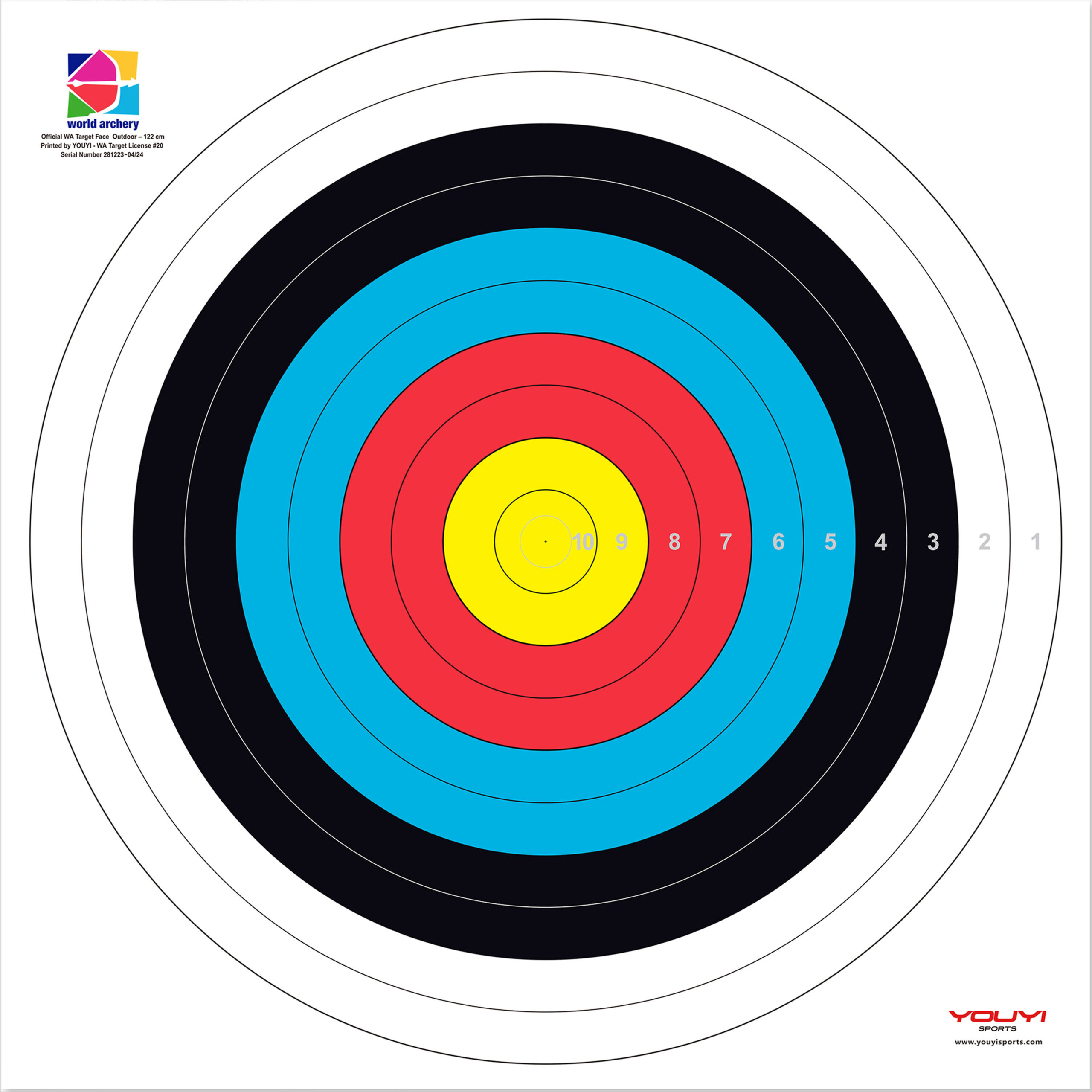
Archery target face size means the diameter of the printed scoring target. World Archery target archery commonly uses 122 cm faces for 70 m recurve, 80 cm faces for 50 m compound, and 40 cm faces for 18 m indoor rounds. The correct face still depends on your event’s rules and target setup.
Key Takeaways
- Target face size is only one part of the round; distance and bow division matter too.
- World Archery examples include 122 cm at 70 m recurve, 80 cm at 50 m compound, and 40 cm at 18 m indoor.
- A paper face does not stop arrows; the buttress and range backstop must suit the bow and arrows.
What does archery target face size mean?
Target face size is the diameter of the printed scoring face, usually stated in centimetres. The face attaches to a target buttress, also called a target boss or butt, which stops the arrow. Face diameter, target distance, scoring format and safe arrow stopping are separate parts of a range setup.
A 122 cm face is roughly 1.22 metres across; an 80 cm face is 0.8 metres across. Those numbers describe the whole circular face, not the centre ring. The scoring rings occupy portions of that circle, and their dimensions are defined by the applicable competition rules.
Which target face size is used at each distance?
World Archery assigns target faces by round, distance and division rather than using one size for all archers. Common examples are a 122 cm face for outdoor recurve at 70 m, an 80 cm face for compound at 50 m, and a 40 cm face for the 18 m indoor round.
| Face diameter | Common World Archery example | Important note |
|---|---|---|
| 122 cm | Outdoor recurve at 70 m | The face and scoring zones are larger than on an 80 cm face. Age and round rules can change the assignment. |
| 80 cm | Outdoor compound at 50 m | Some events use an 80 cm 6-ring face; check whether the event specifies a full face or a reduced scoring face. |
| 60 cm | Used in some short-distance or indoor formats | Do not assume the face from distance alone. Check the event, division and current rules. |
| 40 cm | 18 m indoor target archery | A round may specify a single, vertical or triangular triple face, with scoring details depending on division. |
World Archery’s overview gives the headline outdoor examples: recurve archers shoot at 70 m on 122 cm faces, while compound archers shoot at 50 m on 80 cm faces. The official target archery overview and current World Archery Book 2 rules should be checked for the exact round, division and age category.
For example, an organizer may assign a full 80 cm face or an 80 cm 6-ring face for a particular compound setup. For 18 m indoor rounds, the face may appear as a single spot or as a triple spot. The printed layout, scoring zones and target arrangement are part of the event specification—not just the face’s outside diameter.
Why do the scoring rings change with face size?
Scoring rings are sized as part of the target rules, so a smaller face has smaller scoring zones. On World Archery’s outdoor examples, the 10 ring measures 12.2 cm on a 122 cm face and 8 cm on an 80 cm face. Indoor ring details can also differ by division.
The five familiar colours—gold, red, blue, black and white—are divided into scoring zones. A hit closer to the centre scores more in standard target rounds, but not every event uses the same face layout or ring configuration. Some indoor compound faces have a smaller 10 ring than the recurve face.
That is why a product described as “40 cm triple spot” is not fully specified by its outside size alone. The number of spots, their arrangement and the scoring-ring version matter. For scoring basics, see Suhag Archery’s guide to archery target rings and points.
How should a beginner choose a target face for practice?
Choose the distance and face together, using the range or coach’s direction. For a scored round, use the face and layout named in that round’s rules. For basic practice, a coach may adjust distance or face size to fit the archer, but the buttress must still safely stop the arrows.
- Ask the club or event organizer which round, distance and target face you are shooting.
- Confirm whether the instructions specify a single face, a 6-ring face, or a multi-spot indoor face.
- Use a face that fits the buttress without covering its safe stopping area or placing the target too close to an edge.
- If you are learning, let a coach choose a manageable distance and target size; do not move closer or change the setup without checking the range rules.
- Record the face size and distance with your practice scores so you can compare like with like.
A larger face may help a new archer see where arrows land, while a smaller face can make centring practice more demanding. Those are practice choices, not universal rules. Keep the shooting line, target line and overshoot/backstop area within the range’s safety plan.
What is the difference between a target face and a target buttress?
The target face is the printed paper or fabric with scoring rings; the buttress is the material behind it that catches arrows. A face does not provide arrow stopping. Match the buttress to the bow and arrow energy, inspect it for wear, and use the range’s required backstop.
Suhag Archery lists separate 80 cm, 122 cm and 3 × 20 cm vertical JVD target faces. The 3 × 20 cm vertical face is a multi-spot format; it is not the same as a single 40 cm face. Check the exact product and event format before choosing.
The store also lists an archery target buttress with Indian, recurve and compound variants. The product page describes its construction and size, but those details alone do not establish a safe draw-weight or arrow-energy limit. Ask Suhag Archery or your range manager to confirm suitability for your actual bow and arrows.
A target stand supports the buttress; it does not replace the buttress or a range backstop. Set the complete target securely and follow the maker’s installation instructions. Stop shooting if arrows pass through, rebound, or hit a damaged area.
What should you check before shooting at a target?
Before shooting, confirm that the target face matches the round, the buttress is intact and suited to the arrows, the target is stable, and the area behind it is clear and protected. Keep everyone behind the shooting line until the range is called safe and the group retrieves arrows together.
- Use only the face and distance assigned by the range or competition organizer.
- Make sure the buttress fully covers the likely arrow group and has no worn-through or soft spots.
- Check that the stand cannot tip and that the face is fixed securely.
- Never shoot if a person, animal or vehicle enters the overshoot area.
- Retrieve arrows only after the person in charge stops shooting and confirms the line is safe.
Do traditional and Indian archery use these target face sizes?
Sometimes, but a World Archery face chart is not a universal rule for every traditional or Indian archery format. Local events may set their own target designs, distances and scoring. Check the club or tournament instructions, and use a buttress and backstop rated for the equipment being shot.
If you train with a traditional bow such as Suhag Archery’s Indian bow, ask the coach which face and distance suit that session. Do not assume that a face used for Olympic recurve or compound competition is automatically the right practice target for every traditional setup.
Frequently asked questions
Target size questions are easiest to answer when the distance, event and bow division are known. These short answers cover common World Archery examples; use the current rules for your specific round and confirm that the target buttress is appropriate before shooting.
What size target face is used for archery at 18 metres?
The World Archery 18 m indoor round uses a 40 cm target face. The event may specify a single face or a multi-spot arrangement, so check the round instructions.
What target size is used for Olympic recurve archery?
World Archery target archery uses a 122 cm face for the 70 m outdoor recurve event. Other age groups and rounds can use different distances and face assignments.
What target face do compound archers use at 50 metres?
World Archery’s outdoor target archery overview specifies an 80 cm face for compound archers at 50 m. Some events use a reduced 6-ring layout; follow the event rules.
Is an archery target face the same as a target buttress?
No. The target face is the printed scoring surface. The buttress behind it catches arrows, and a safe range may also require an overshoot backstop.
Can beginners practise on a larger target face?
A coach may choose a larger face or shorter distance for practice, but the target and buttress must still suit the arrows and comply with the range safety plan.
Conclusion
Use the target face named by your round, and confirm distance, division and face layout before practice. For informal sessions, follow your coach’s setup and range safety plan. Match the printed face to a stable, suitable buttress; the face itself cannot catch or stop an arrow.