
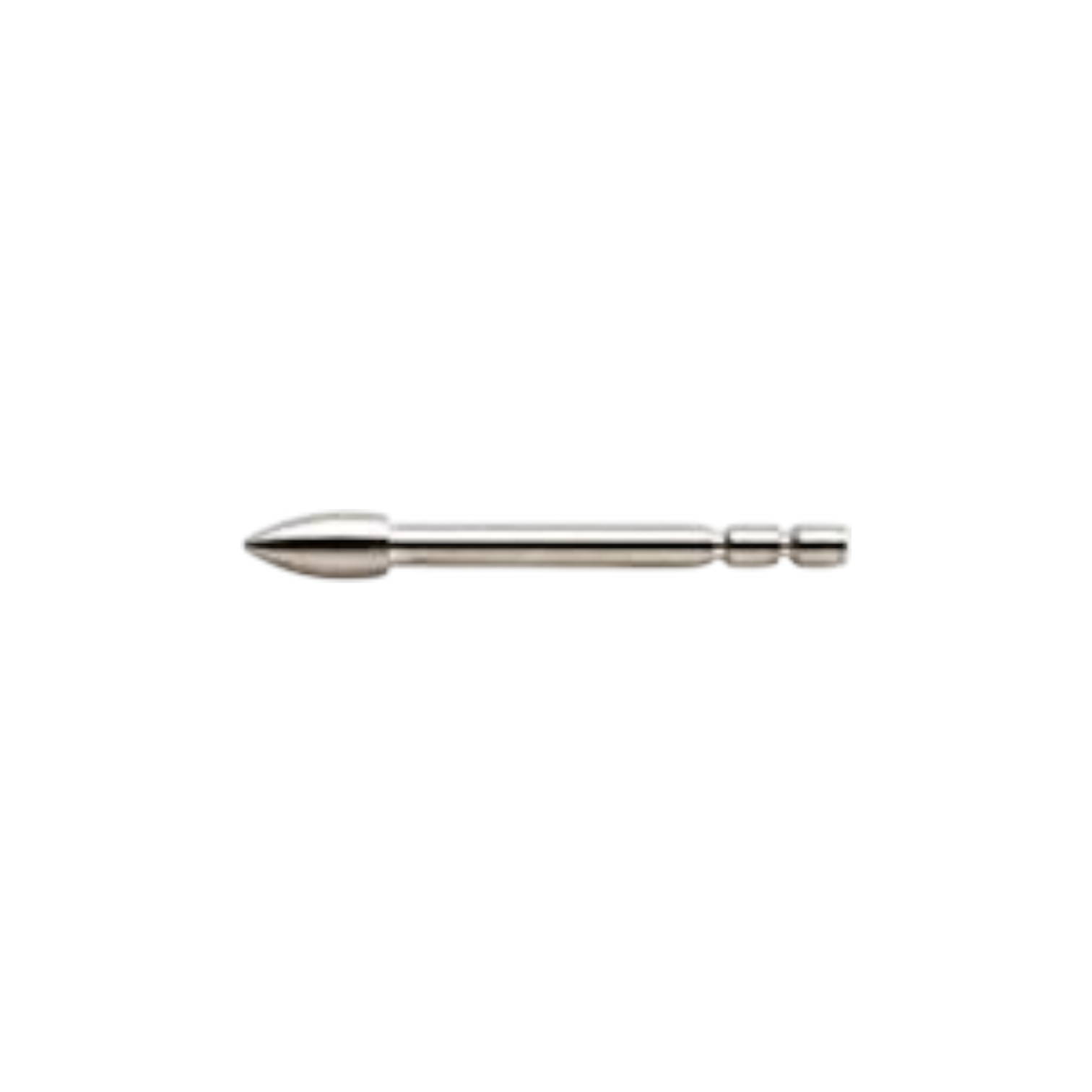
Arrow point weight is the mass of the point at the front of an arrow, usually stated in grains (gr). It affects the arrow’s total mass, balance and tune. A heavier point generally makes an arrow react dynamically weaker; the right choice still depends on the shaft, arrow length, bow and manufacturer’s component range.
Key Takeaways
- Use the arrow maker’s spine chart and point-weight range as your starting point.
- Changing point weight can change dynamic spine, front-of-centre balance, total mass and tune.
- Adjust one variable at a time, and have a coach or technician check an uncertain setup.
What does arrow point weight mean?
Arrow point weight is the mass of the front point, commonly measured in grains. One grain is about 0.0648 grams, so a 100-grain point is about 6.48 grams. The stated weight describes the point itself, not the complete arrow or its total front-end assembly.
Archery product labels often use “gr” for grains. A point may be fixed weight, adjustable, or designed so sections can be removed from a break-off point. The insert or outsert is another front component; its mass also contributes to the complete arrow’s front-end weight.
Do not compare two points by grain weight alone. Check the shaft’s point fitment, the exact point model, whether the listed figure includes an insert, and the arrow maker’s recommended range. A point that does not fit the shaft securely is not a tuning option.
Does a heavier point make an arrow spine weaker?
Usually, a heavier point makes a shaft behave dynamically weaker, while a lighter point tends to make it behave stiffer. Static spine is the shaft’s measured stiffness; dynamic spine describes how it responds during the shot. This is a tuning tendency, not a substitute for selecting a compatible shaft.
When the bowstring accelerates the arrow, the shaft flexes and recovers. Arrow length, shaft stiffness, point mass, bow weight at the archer’s draw length, release style and the bow’s setup all affect that response. A spine number alone does not describe the entire arrow-and-bow system.
Easton’s tuning guide describes point and insert weight as one adjustment for certain arrow families: if an arrow reacts too weakly, it suggests trying a lighter front component; if it reacts too stiffly, it suggests trying a heavier one within the acceptable balance range. Use the instructions for the arrow you own; component systems differ.
If you need a refresher, read Suhag Archery’s guide to what arrow spine numbers mean. Also confirm the finished shaft length using the guide to measuring arrow length safely. Length and point weight should be considered together, not adjusted from a spine label in isolation.
| Change from your current setup | Typical tendency | What to verify |
|---|---|---|
| Use a lighter point | The arrow may react dynamically stiffer, with less mass at the front. | Confirm the point remains within the maker’s range and retest the tune. |
| Keep the same point weight | Your current front-end mass remains the baseline. | Check that arrow spine, length and bow setup are otherwise correct. |
| Use a heavier point | The arrow may react dynamically weaker and carry more mass forward. | Check the tune, total arrow mass and the shaft maker’s limits. |
What else changes when point weight changes?
Changing point weight also changes total arrow mass and can move the balance point forward or backward. A heavier point often increases front-of-centre (FOC), meaning the balance point sits farther ahead of the shaft’s midpoint. It can also change speed and impact behaviour, so assess the whole setup.
All else equal, adding mass usually reduces launch speed for the same bow. The amount depends on the bow’s energy transfer and the complete arrow, including shaft, fletching, nock and insert. Do not predict a particular speed change from point weight alone.
FOC is a description of balance, not a score of arrow quality. A higher number is not automatically better. Easton notes that excessive FOC can lower dynamic spine and create tuning problems. For a detailed definition and calculation, see Easton’s FOC guidance.
How do you choose a starting arrow point weight?
Start with the chart for the exact arrow model, actual bow weight at your draw length, and finished arrow length. Then check the point’s fit and the shaft maker’s permitted weight range. There is no single grain weight that suits every archer, bow, shaft or shooting style.
For example, moving from a 100-grain point to a 120-grain point adds 20 grains, or about 1.30 grams, to the front of each arrow. That comparison describes mass only. It does not mean that 120 grains will tune better, shoot faster or score higher for your bow.
Use the manufacturer’s arrow selector when it is available. Easton’s current target guide bases selection on factors such as bow weight and arrow length, and its selector adjusts for component choices. If your setup sits between chart sizes, ask a qualified coach or archery shop to confirm the shaft and point combination.
Suhag Archery lists Easton X10 ballistic tungsten points for compatible X10 and ProTour shafts in several weight configurations. Easton likewise specifies the shaft models and available options on its manufacturer product page. Check the exact shaft, point fitment and selected weight before ordering; those options are not interchangeable with every arrow.
If you are choosing an arrow as well as a point, Suhag’s Easton X10 arrow listing asks buyers to select the shaft spine and whether points are included. Match those selections to your bow and the current Easton chart rather than choosing by brand or appearance.
How can you change point weight methodically?
Change point weight only after confirming the arrow is undamaged, correctly spined, correctly cut and compatible with the bow. Establish a repeatable baseline, alter one variable at a time, then compare groups and tune at a proper range. Follow the component maker’s instructions or ask a coach to supervise.
- Record the shaft model and spine, cut length, point and insert weights, bow weight at your draw length, and current tune.
- Check that the point type fits the arrow and that the proposed weight is within the shaft maker’s range.
- Change only the front component on a matched set of arrows. Do not mix different point weights in one group without marking them clearly.
- At a safe range, compare groups using the same bow settings, distance and shooting routine. A coach can help interpret a bare-shaft or paper-tune result.
- Stop if a point is loose, a shaft is damaged, or the arrow behaves unpredictably. Have a qualified technician inspect the setup before shooting again.
Do not force a point into an incompatible shaft or improvise by grinding, drilling or heating a carbon arrow. Some point systems are removable; glued-in systems require the shaft maker’s assembly method. When in doubt, let an archery shop fit or replace the component.
When is point weight not the right fix?
Point weight cannot make an unsafe or badly mismatched arrow safe. If the shaft is cracked, the nock or point is loose, the spine is outside the maker’s chart, or arrows strike the bow, stop shooting and investigate those causes first. A coach should check the bow and arrow before further tuning.
Inconsistent groups can also come from a changing anchor, release, bow hand, rest position or nocking-point height. Tuning is most useful after the archer can repeat the shot and the bow is mechanically sound. Change one thing at a time; otherwise it becomes difficult to identify what improved or worsened the result.
Does point weight selection differ for traditional and Indian archery?
The same principle applies—front-component mass can affect an arrow’s dynamic response—but modern aluminium-carbon spine charts do not automatically apply to wooden or bamboo arrows. Traditional shafts, bow design and release method vary, so choose spine and point with the bowyer’s or arrow maker’s guidance.
For a traditional Indian bow, check the specific bow, draw length and arrow construction with a coach or maker before choosing a point. Suhag Archery’s Indian bow listing describes a different bow format from an Easton target-arrow system; do not assume the X10 chart or tungsten point fitment transfers to it.
Frequently asked questions
These quick answers clarify grain units, the usual direction of point-weight changes on dynamic spine, and when it is safe to experiment. Always confirm the shaft model and manufacturer’s component range first; a point that fits one arrow family may not fit another.
What does 100 grain mean on an arrow point?
It means the point itself has a mass of 100 grains, about 6.48 grams. It does not describe the total mass of the arrow or its complete front-end assembly.
Does a heavier point make an arrow spine weaker?
Usually, a heavier point makes an arrow react dynamically weaker, while a lighter point tends to make it react stiffer. Confirm the direction and acceptable range with the shaft maker’s tuning guide.
Will a heavier arrow point make my arrow slower?
Adding point mass usually lowers launch speed when other parts of the setup stay the same, but the amount depends on the bow and complete arrow. Measure or consult a qualified shop rather than assuming a fixed speed change.
Can I change the point weight on any arrow?
No. Use only points and inserts designed for that shaft, within the manufacturer’s weight and assembly limits. Ask a technician to fit glued components or investigate uncertain compatibility.
How do I choose the right arrow point weight?
Use the arrow maker’s chart for the exact shaft, spine and length, then account for your bow setup and intended use. A coach or qualified archery shop can help confirm the selection and tune.
Conclusion
Arrow point weight is one part of arrow selection and tuning. Use the shaft maker’s chart to choose a compatible starting point, then confirm the result with a controlled setup and safe shooting checks. A heavier or lighter point is an adjustment—not a universal upgrade or a fix for damage.